
Retail delivery: “ready for pick-up”
In shortWhy customers try to pick orders up early, how Getcho makes sure drivers don’t show up early for same-day delivery orders, and the next evolution: data-driven delivery dispatch timing.
Retail delivery: “ready for pick-up”
Here’s a gripe that many retail workers have: a customer arriving to collect an in-store pick-up order that isn’t ready. It’s universal. That’s why you see such consistent verbiage on the order confirmation emails:
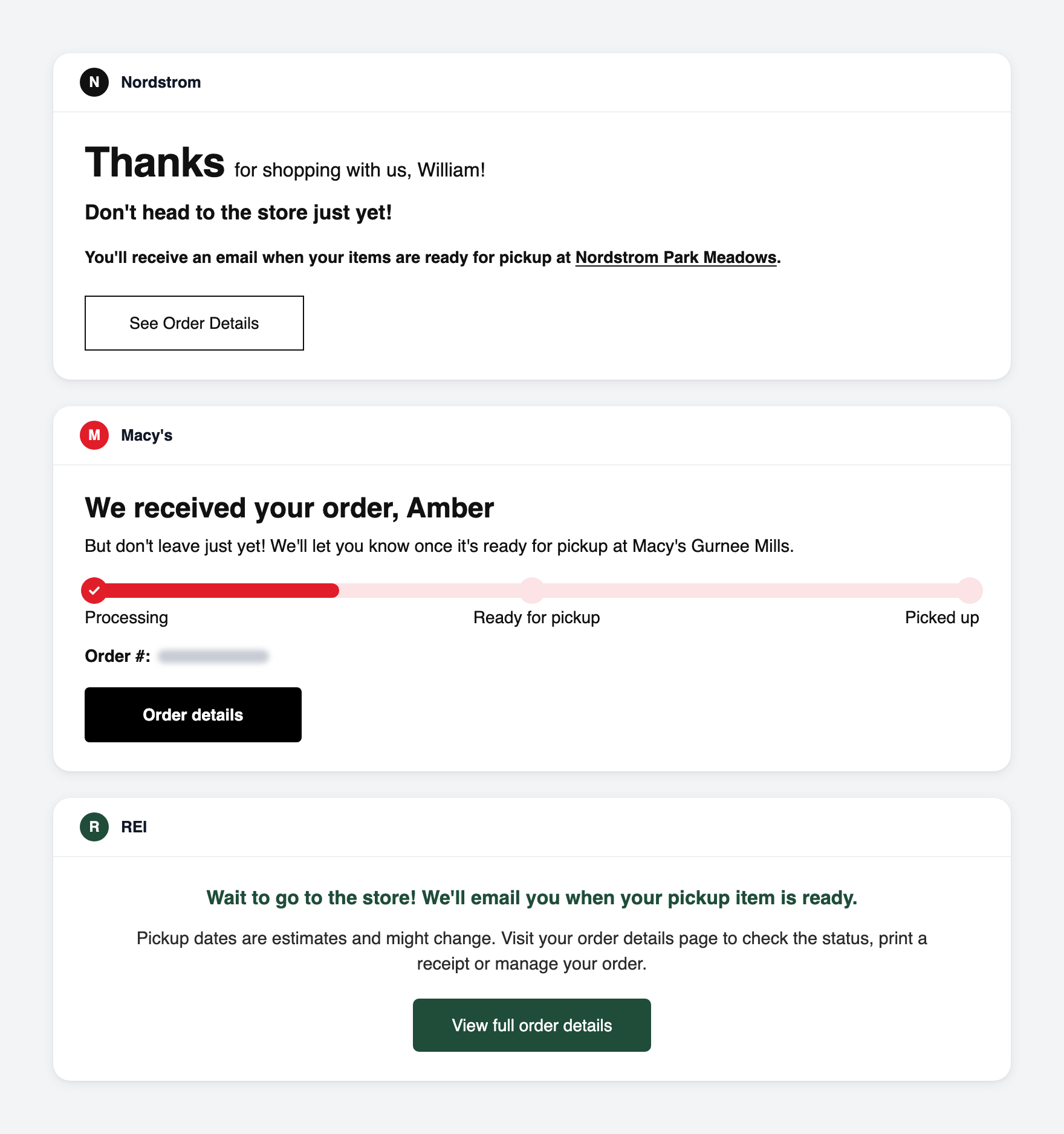
Getcho is a fulfillment platform; many of our customers use Getcho to fulfill store orders. So we’re intimately familiar with every side of the problem.
Why customers try to pick orders up early
For many shoppers BOPIS is just a way to ensure a trip to the store is fruitful. If they can’t find anything or the product is sold out, they wasted the drive. Plus it’s often faster and easier to browse a store catalog online.
To the customer, BOPIS is the same as an in-person shop except they’ve guaranteed their order. How counter-intuitive it is that one can buy something on a whim in a store, but another thing bought online ahead of time might not be ready.
Retail staff can tell you why: BOPIS is sometimes more like eCommerce than retail. The order might not be on the floor but in a back warehouse area, or even at another location requiring a same-day transfer. Picking and packing is more of a process than picking an item off a shelf. There’s the disconnect.
The best solution is to make sure to communicate the process. REI, Nordstrom and Macy’s all say in no uncertain terms to wait for a second email. Some businesses indicate more precisely where an order is – in transit from the warehouse, being located or packed – so customers don’t assume that the bottleneck is grabbing it off the shelf.
Ensuring drivers don’t show up early for same-day delivery orders
Ship-from-store also straddles the fence between retail and eCommerce. Getcho has the top-rated, Built for Shopify same-day delivery app. Incidentally same-day delivery is often a bit of a release valve for early arriving BOPIS orders – it scratches the itch of fastest possible fulfillment.
The first onboarding question we get is “are drivers going to show up right when the order is placed? Because it won’t be ready yet!”. We answer that we send our drivers at precisely the moment an order is ready. The next question is “how will you know it’s ready?”.
Getcho supports three mechanisms for indicating order readiness:
- Order fulfilled. When Ninja Transfers hits the fulfillment button in Shopify we know it’s ready. When we pick it up we update the fulfillment with the live tracking link.
- Label printed. When Minus Moonshine prints the Getcho label from Shopify, the message is clear: the order is ready. Upon pick-up, the Getcho app fulfills the order and adds live tracking.
- Timed readiness. Bitters & Bottles customers can select delivery windows that are at least an hour in advance at checkout – they keep all SKUs on the shelves and pack according to the pickup time (i.e. the tail wags the dog).
WMS same-day delivery: same song, different verse
Our partners offering same-day delivery out of a 3PL operate similarly. We get a copy of the same-day delivery order when it’s placed; when the fulfillment team packs the order, they’ll print a label – a Getcho-provided label – which is our cue to send the driver.
With Highline Commerce, for instance, we integrate with their WMS, Packiyo. Packiyo asks Getcho for a rate, and then for the label, which signals to the dispatch workflow that the order may be picked up.
The next evolution: data-driven delivery dispatch timing
Sometimes it makes sense to dispatch preemptively. For instance, if we know that a label will be printed at 2pm, why wait until 2pm to send for a driver?
The time between dispatch and pick-up (“time to pickup”) is lost time.
Thus Getcho supports subscribing to an “almost ready” fulfillment signal, some sort of sign that an order will be packed at a time soon. It can be as rudimentary as an employee choosing “ready at 2pm” from the Getcho app, or as sophisticated as Getcho predicting a ready time based on other similar orders.
Take Ninja Transfers. They’re a leading DTF company. Getcho subscribes to their production tracking system and knows that a DTF being cut might have 25 minutes before packing. This gives us a head start on delivery; that order never stopped moving, from a design to machine to vehicle to doorstep.