
67 Wine + Getcho: Delivery Priced to What It Actually Costs
A third-generation Upper West Side wine merchant was losing money on deliveries that looked fine at checkout. Modeling true delivery cost, pricing checkout options to match, and routing Brooklyn and Queens to third-party fleets cut shipping unit costs 11%, lifted shipping unit revenue 6%, and eliminated every loss-leading local delivery.
The Results
- Shipping unit costs down 11% and shipping unit revenue up 6%
- 100% of loss-leading local deliveries eliminated. Every delivery is now priced the way it should be
- 3x order volume in Brooklyn and Queens, now served every day instead of on a weekly batched run
- Checkout options customers actually want: ASAP, white-glove and anytime delivery, tailored to zip code and address type
Customer sentiment followed. A few of the messages sent to 67 Wine’s customer service line:
“Thank you for the timely delivery. Much appreciated."
"Thank you. I am very impressed with the quality of your delivery service."
"Great service & Excellent communication & love the live GPS!!"
"Thanks so so much for the amazing and quick service no issues at all!!”
The Challenge
67 Wine is a wine merchant on New York City’s Upper West Side, on 67th Street in fact. 67 Gourmet, a separate business under the same ownership, sells non-alcoholic products down the street: cheese, spreads and sparkling beverages.
David Weiser is the third-generation owner of both. He’ll be the first to tell you that while many things have stayed the same, many have changed, and delivery has changed the most:
- There are far more deliveries. Orders used to be phoned in or placed in store (wine is heavy!). Ecommerce opened the floodgates.
- Customer expectations are much higher. In the world of Amazon, shoppers want cheap or free shipping, and they want it fast.
- Third-party delivery providers dominate the landscape. A shop like 67 Wine might once have had a few in-house drivers; now it dispatches to a mix of in-house drivers and third-party fleets to meet demand efficiently.
- The rules changed. Regulation of alcohol delivery in New York City has shifted over the last decade.
Both Sides of the Checkout
Every local merchant, and wine merchants especially, faces the same predicament:
- Delivery is a must. It’s half the market or more, even for a neighborhood shop.
- Delivery economics are dangerous. They can push an order’s margin negative.
On an in-store sale, margin is predictable: retail price minus wholesale cost. Delivery adds two new variables that can push a sale into the red:
- Shipping revenue, collected from the customer at checkout
- Delivery cost, paid to the carrier
The gap between them is the shipping deficit: true delivery cost minus what the customer paid for shipping. (It can run the other way, too. Zone 1 express options often cost the customer more than they cost the business.)
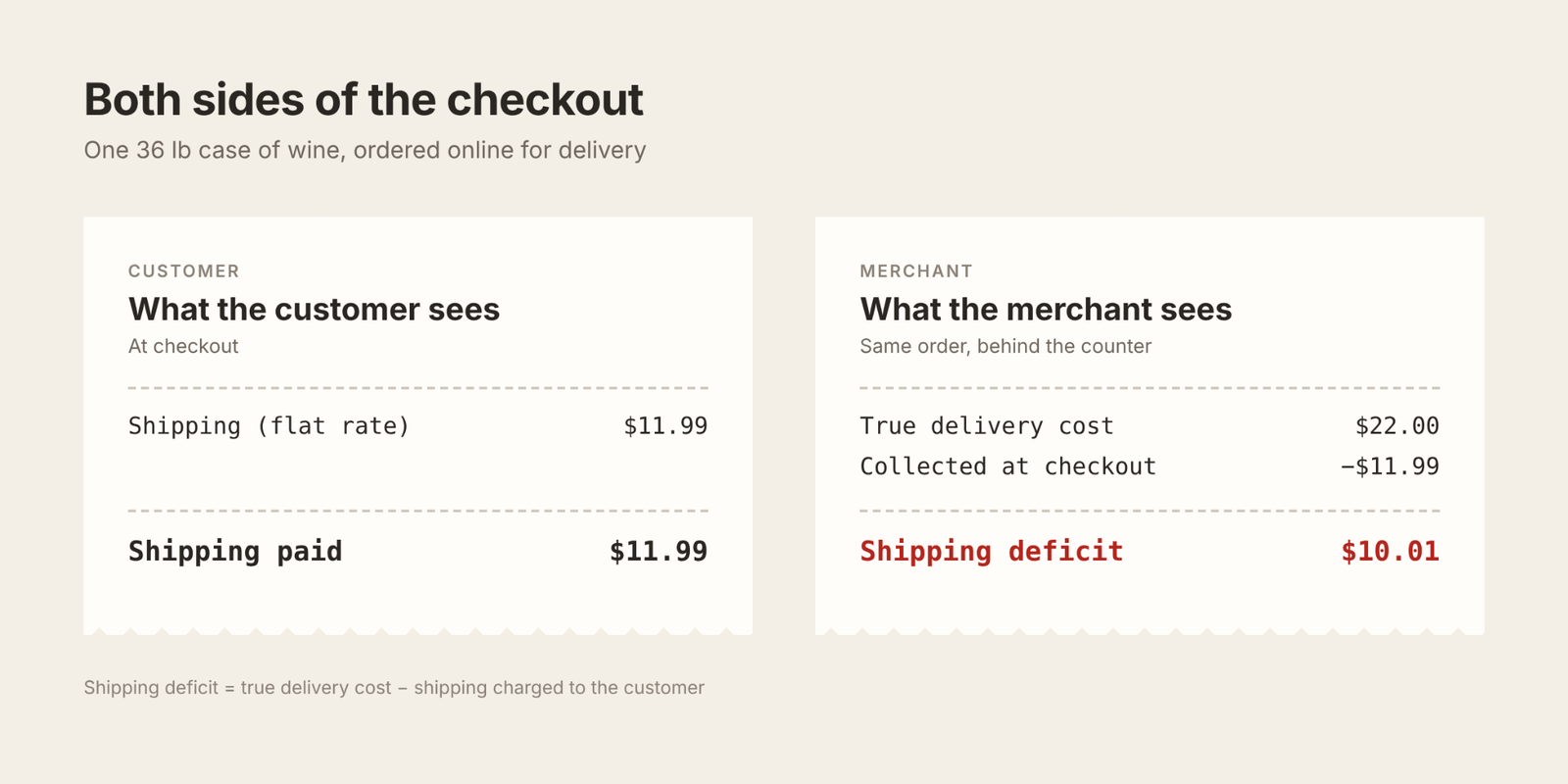
Most shipping tools manage only one side of that equation. Getcho manages both: it sets the rates shoppers see at checkout through Shopify Carrier Rates, and it lowers what deliveries cost through local carriers and economies of scale. Managing the shipping deficit is our bread and butter.
Lever One: Delivery Cost
The first thing we did with 67 Wine was analyze what deliveries actually cost. Each option prices differently: in-house drivers have their own cost structure, third-party fleets like Uber, Roadie and DoorDash price by the mile, and local carriers like Flot and DBX price on other factors. Using real rate data alongside order urgency, customer preference and batching discounts, we modeled the true cost of every delivery.
Next, we looked for loss-leading deliveries, where a high shipping deficit lands on a low-margin order. These are usually worse than no delivery at all, because they eat up store time on top of the money. (A loss leader can be acceptable for a high-value customer who makes up for it with frequent orders, but it should be a choice, not an accident.)
A few themes emerged:
- Corporate gifts were priced like residential orders. All else being equal, the store charged the same for a corporate gift delivery as for a regular home delivery.
- Corporate gifts cost far more to deliver. The receiver is open only during select hours and often isn’t expecting the order, so it’s harder to schedule. Commercial receivers sometimes require special paperwork like LOIs or white-glove service (carted up to the 48th floor), and they end up return-to-sender three times as often. Returns are no fun: many merchants eat the cost.
Lever Two: Delivery Revenue
With true costs in hand, we could help 67 Wine price deliveries in proportion to what they cost. That’s the second lever Getcho controls.
But before settling on a simple cost pass-through, we wanted to understand what customers valued, and whether they could say so at checkout. 67 Wine’s customers want very different things:
- Decades-long customers expect the driver to bring the order up to their unit, open the box and show them the wine.
- Newer customers want their wine in under two hours, without fanfare. That was mostly impossible ten years ago, before third-party fleets took off; in-house drivers usually have several stops on a route and need much more lead time.
- Some customers want the order left with their doorman, no interaction at all.
So we let them choose. The cart page now offers ASAP, white-glove and anytime delivery, each priced for the customer’s zip code and address type. Customers get the service they want, and every option covers its cost.
Opening New Markets: Brooklyn and Queens
Expanding a delivery radius is the same thing as expanding a market. 67 Wine’s drivers used to make weekly batched runs to Brooklyn for a fixed fee.
We found that third-party fleets with larger service areas could deliver to Brooklyn, and Queens, every day for a lower cost than the weekly run. Changing the delivery cost function in those boroughs improved the shipping deficit on those orders and tripled their order volume.
Merchants use Getcho to manage both sides of the shipping deficit: accurate carrier rates at checkout through one Shopify integration, and every delivery dispatched to the in-house driver, third-party fleet or local carrier that does it best for the least.
Key Takeaways
- Watch the shipping deficit, not just delivery cost. An order’s delivery margin is shipping revenue minus delivery cost; managing only one side leaves money on the table.
- Find the loss leaders. Corporate gift deliveries looked like residential orders at checkout but cost far more to complete, with tight receiving windows, white-glove requirements and three times the return-to-sender rate.
- Let customers pay for what they value. ASAP, white-glove and anytime options, priced by zip code and address type, gave 67 Wine’s customers choice while keeping every option profitable.
- A cheaper cost function opens new markets. Daily third-party delivery to Brooklyn and Queens beat a weekly fixed-fee run on cost and tripled order volume there.
- The numbers moved together. Shipping unit costs fell 11%, shipping unit revenue rose 6%, and loss-leading local deliveries went to zero, while customers praised the speed, communication and live GPS tracking.