Dispatch workflows for logistics & ops managers, Part 1
In shortThree dispatch workflows Getcho businesses use: delivery recovery, pre-delivery stall detection, and freight coordination between shipper, receiver, carrier and brand.
Dispatch workflows for logistics & ops managers, Part 1
Getcho is a local delivery and shipping platform. We lead the industry on the reliability/cost matrix. Our secret is that we have years of experience in the trenches – dispatching, handling customer experience and obsessing over shipping data. So we’ve been able to automate many of the hairy parts of logistics with “dispatch workflows”. Our partners sleep easy knowing they’re using bleeding edge AI to handle things no human wants to deal with – looking at delivery photos, providing precise ETAs based on macro patterns, backing up deliveries when one provider doesn’t seem to be assigning. Interested in a dispatch automation audit? Book a call and we’ll offer some tailored advice.
A dispatch workflow is an automation driven by:
- Deliveries
- Delivery events such as “en route to drop-off” or “rescheduled”.
And it’s actually two-way: deliveries drive dispatch workflows AND dispatch workflows drive deliveries.
Example 1: delivery driving a dispatch workflow
A delivery’s ETA window changes; the dispatch workflow kicks off a notification sequence to the warehouse team to adjust the dock appointment.
Example 2: a dispatch workflow driving a delivery
A change in inventory causes the dispatch workflow to delay a delivery for two days when a replenishment is expected.
The loop sort of takes on a life of its own. We see true intelligence play out as dispatch workflows iterate. An event happens that updates the delivery; downstream teams are notified to make requisite updates; they may adjust the delivery again until it settles into an optimized configuration.
Dispatch workflow #1: delivery recovery AKA falling back to another fleet
This one is a very practical workflow. So we dispatch a hundred orders and come back a few hours later and find that a few of them failed.
- Two of them never found a driver at all
- On one of them the driver sat on the order and then cancelled
- For one of them, the driver accidentally marked the order as picked up, so the failure isn’t even apparent.
So a poor employee then checks these and reenters the three deliveries again, possibly updating the customers manually… A few hours later, rinse and repeat.
Or maybe they didn’t fail, they’re still sitting there. But it’s apparent that they probably won’t ever be assigned. So someone cancels them and books a different carrier.
If this describes the responsibility of someone in your operation: there is a better way! Getcho’s recovery workflow monitors delivery failures or potential failures – those deliveries sitting for hours. Based on context like the acceptable delivery window, previous carrier timing, delivery data (GPS, photos) Getcho will quietly arrange a backup before it’s actually needed.
For fleets like Roadie that show prospective drivers net compensation, we use a tip ladder to build incentives as things get more delayed. True failures on any fleet are assessed within a few milliseconds - rebook on the same fleet? Change carrier based on today’s assignment data?
It’s like the most tuned-in logistics manager is staring at each of your deliveries with superhuman intelligence when it comes to traffic awareness, fleet capacity and customer expectations.
Businesses like Mad Rose, Highline Commerce, RushOrderTees and Farm Link Hawaii send their local deliveries through Getcho. They’re all safe to consider them monitored and handled - no one needs to login and check whether they should tap a back up.
Want to learn more about recovery workflows? Book a call and we’ll get you started.
Dispatch workflow #2: pre-delivery stall detection
There are plenty of bottlenecks within delivery:
- Driver assignment
- Intermediate stops for batched orders
- Traffic spikes
But some of the most important bottlenecks occur before dispatch: fulfillment routing, pulling and packing
Fulfillment ultimately kicks off a Getcho dispatch. But the platform can’t be blind to what happens before dispatch, lest an order sit unfulfilled on a same-day delivery promise we made.
Thus Getcho supports workflows that can communicate with the teams doing the pulling and packing:
- Store teams can enable our Shopify POS workflow, which sends a push notification to the POS app’s tablet when an order sits past a certain window.
- Some very scrupulous store teams even enable auto call/sms alerts when a backlog starts to grow.
- Warehouse teams commonly subscribe to workflows in Slack and email. As cutoff times approach, alerts fire making sure things don’t fall through the cracks.
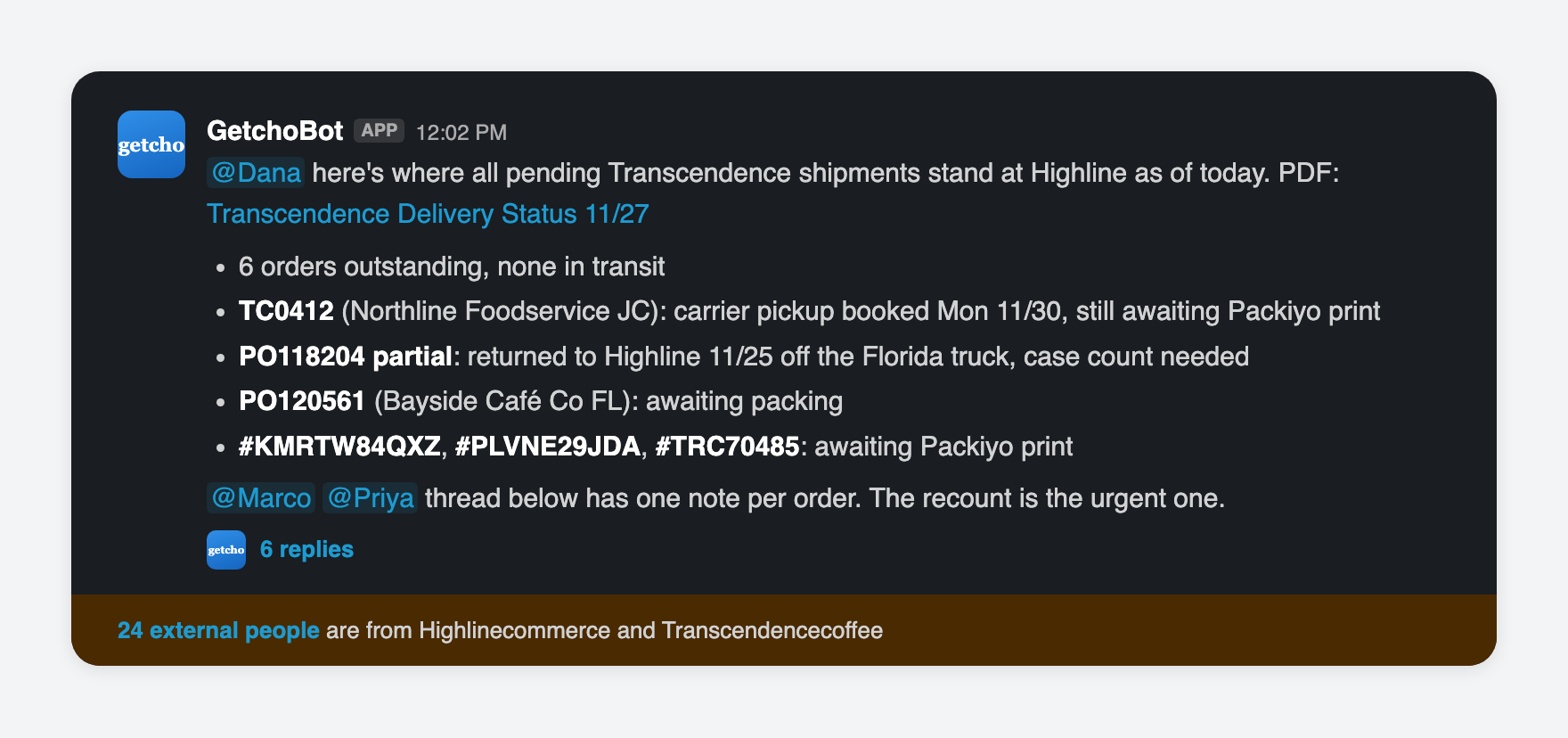
Some notifications in various Highline Commerce slack channels.
Dispatch workflow #3: freight coordination between shipper, receiver, carrier and brand
Getcho allows businesses to integrate their freight carriers and brokers onto its transportation management dashboard. The regional fulfillment platform Parsel, for example, has integrated their first and middle mile carriers into Getcho to create a unified view of all their freight. That has allowed Parsel to subscribe to freight alerts relevant to them using their real data. Does a window need to be adjusted? Does the receiver need to be notified? Or does history say this carrier is just a little slow to update their tracking?
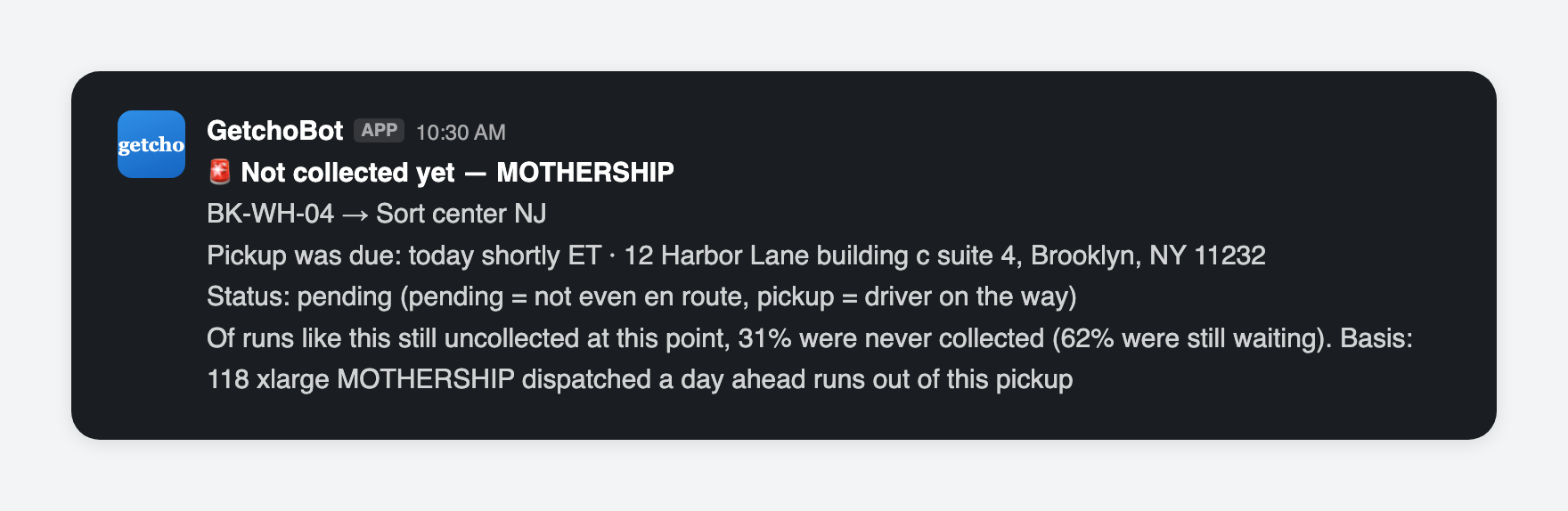
One very powerful application: brands like the very popular Transcendence Coffee can organize their distribution runs on Getcho using freight workflows.
The Getcho platform coordinates with their suppliers on pack dates, pick-up windows and readiness statuses. BOLs are generated, delivery appointments are scheduled based on transit projections. When constraints don’t agree – “Needs to be delivered by 12/1” and “To be packed on 12/2”, for example – decisions are bumped up to Transcendence. Otherwise they need not concern themselves with logistical annoyances; their Getcho dashboard has all their shipments tracked and monitored when they want to check in.
These are three of many highly useful workflows Getcho businesses use. More to come soon on Part 2!